
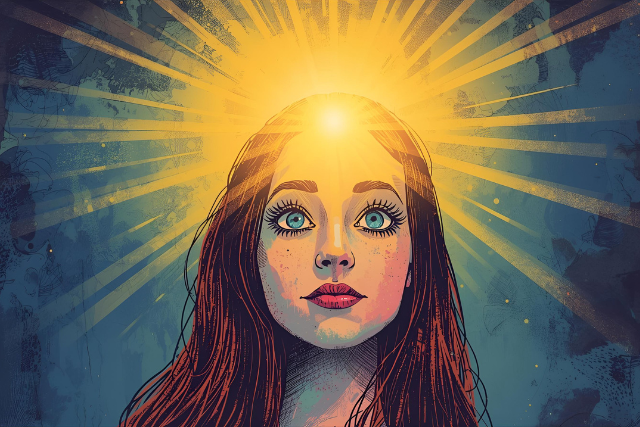
There’s a familiar darkness that visits me—not as an enemy to be banished, but as a presence that insists on being acknowledged. It doesn’t speak in words; it settles like a weight in my chest, a silent pressure that refuses to be ignored.
From a very young age, I learned to carry the heavy emotions of those around me. At two, I could sense my grandmother’s deep sadness—her belief that she was unloved. That despair trickled into my small world, shaping it in ways I didn’t understand.
By three, I was comforting my mother as she wept, whispering words meant to soothe her even though I barely understood why she cried. I was a child forced into the role of caretaker, doing the best I could with the little strength I had.
At four, the memory is sharp—I was on the porch, singing a quiet song to myself, hoping my mother would come. She had been absent for two years, pulled away not by court battles but by the chaos that often defined families back then—abductions, separations, trauma. My mother, a survivor of domestic violence, carried scars deeper than I could see. Her depression grew, casting a shadow over our lives. All I knew was I missed her terribly. So, I sang.
Years passed, and pain continued to build inside me. At twelve, I stood beside the casket of my best friend, feeling a sorrow so vast it never fully left me. It ebbed and flowed but remained a quiet companion.
At fifteen, I stole a pair of floral shorts—something small to help me fit in, a way to mask the ache beneath my smiling green eyes. I was waiting for a love that could save me, but even then, the emptiness lingered.
By twenty-two, life felt unbearably heavy. My mother was hospitalized again, her mental health struggles now diagnosed as bipolar disorder, often accompanied by psychosis. Alone in my tiny apartment, I reached for household chemicals, contemplating an escape from the pain. But I stopped—something inside me clung to a fragile hope.
I found solace in the soft purring of my cat and the quiet words of a small book of scripture. In that moment, I chose life.
The darkness hasn’t always been a shadow outside myself. Sometimes, I’m trapped in memories—reliving the hurt from a distance, watching my younger self suffer quietly. I’ve learned that when darkness surfaces, it’s because it wants to be seen, held, and loved.
Healing has not been immediate or simple. It’s been a slow unraveling of pain and self-compassion, guided by an unexpected path called Brainspotting.
Brainspotting is a therapeutic approach rooted in mindfulness. It uses eye positions to connect with what the body feels but the mind can’t easily reach. This method allows buried trauma and grief to surface in a way words alone can’t unlock.
I discovered Brainspotting first as a therapist searching for my own healing and for ways to help clients who mirrored my struggles. Over countless sessions—sometimes alone, sometimes with my therapist—I dove deeper into my inner world. My body revealed memories and protective patterns I’d built as a child to survive.
With each session, I grew kinder to myself. I learned to sit with difficult feelings instead of dissociating. I began to understand how trauma is stored in the nervous system—not just the mind.
This wisdom didn’t come all at once. It’s an ongoing journey of meeting my past self with gentleness, reclaiming my voice, and choosing to live from the adult I am now rather than the scared child I once was.
One evening, far from home and away from someone I loved, the old ache rose again. There was no immediate crisis—just the quiet pressure of distance and loneliness stirring something buried deep inside. I found a quiet spot, closed my eyes, and let the images come: grief, survival, and years of unspoken sorrow. As I moved through them, my chest softened. The pain that had once felt overwhelming became something I could hold tenderly.
The next day, I woke feeling lighter, more grounded. I didn’t have all the answers, but I had something just as vital: the capacity to stay present with pain without fear, to listen instead of panic, to navigate intimacy and uncertainty with myself as an anchor.
Healing isn’t about fighting the mud of trauma. It’s about recognizing that pain is wisdom wrapped in that mud—messy, heavy, yet fertile ground where growth is possible when the conditions are right. Like a lotus blooming from the darkest waters, healing emerges when we learn to hold our darkness with love and curiosity.
If you’re carrying your own shadows today, know this: you don’t have to fight alone. There are paths to healing that honor both your pain and your strength. Sometimes, the bravest act is simply letting yourself be seen—by yourself and by others.